A Transnosographic Clinical Framework for Play-Focused Psychodynamic Semiresidential Community Treatment
Grassi Antonio1, Berivi Sandra2, Casamassima Stefania3, Russello Carla3, Benedetta Romano4, Sinatti Cristiana5, Alvisi Francesca6 .
1 Psychiatrist, Medical Director, Istituto San Raffaele Monte Mario; President, Italian Laboratory for Research in Analytical Psychology — LIRPA;
2 Psychologist and Training Analyst; Vice President, Italian Laboratory for Research in Analytical Psychology — LIRPA;
3 Psychologist, Italian Laboratory for Research in Analytical Psychology — LIRPA;
⁴ Psychiatrist, Outpatient Clinic and Day Center “La Mongolfiera”, Adult Disability Service, District XIV, ASL Roma 1;
⁵ Psychiatrist, Outpatient Clinic Coordinator, Adult Disability Service, District XIV, ASL Roma 1;
⁶ Neuropsychiatrist, Director of UOSD — Residential Care and Supported Housing, District XIV, ASL Roma 1.
Keywords: behavior; depression; play; death; healing.
Abstract:
By following the trajectory outlined by the spectrum of behavioral disorders, understood in their dimensional rather than merely categorical sense, the authors identify play as both the common factor and the shared instrument of psychotherapeutic intervention. They further recognize the experience of death and “resurrection” as the event capable of restoring and healing both the individual and our contemporary social order.
INTRODUCTION
In this paper, we have sought to balance a radically categorical nosography with a specifically dimensional one, that is, one based on the dimensional gradation of symptoms. More specifically, we have considered behavior and its disorders.
This has enabled us to bring to the reader’s attention a rather broad range of disorders that, until now, have been considered only from a categorical perspective, thereby opening up a scientifically relevant interpretive perspective that differs from the customary one.
Historical References
The concept of Behavioral Disorder has undergone continuous evolution throughout the history of neuropsychiatry. Initially, behavioral alterations were interpreted in moral or religious terms, often associated with demonic possession or deviations from social norms. Only with the advent of modern psychiatry did these disorders begin to be considered medical and psychological conditions.
In the nineteenth century, with the emergence of scientific psychiatry, behavioral disorders began to be classified into more clearly defined categories. The evolutionary approach played a key role in the understanding of these disorders, seeking to explain their causes through natural selection and adaptation. In the twentieth century, psychiatry developed more complex models for interpreting behavioral disorders. In the 1930s, thanks to Fisher’s studies, together with Haldane, neo-Darwinism emerged. In the 1960s, evolutionary theory came to play a central role in the explanation of mental disorders, with experimental studies analyzing human behavior from an adaptive perspective.
In the 1980s and 1990s, research highlighted the importance of neurobiological and environmental factors in the genesis of behavioral disorders. Neuroscientific studies demonstrated that certain brain alterations may predispose individuals to disruptive behaviors, while the social and family environment plays a crucial role in their manifestation.
The Current State of the Art
Classification and Characteristics of Behavioral Disorders
Today, behavioral disorders are classified into several categories, including:
- Oppositional Defiant Disorder (ODD): characterized by defiant attitudes, irritability and opposition to rules, violation of social norms, and a tendency toward manipulation.
- Behavioral disorders in developmental age: these include difficulties in adaptation, learning problems, and emotional-affective disorders.
- Attention-deficit/hyperactivity disorder (ADHD).
- Autism spectrum disorders (ASD) with behavioral problems.
Therapeutic Approaches and Future Perspectives
Psychotherapy and Psychoeducational Interventions
- Psychodynamic or cognitive-behavioral psychotherapy:
- helps modify distorted thoughts and dysfunctional behaviors.
- improves self-regulation, anger management, and social skills.
- is often used with children and adolescents with ODD and CD.
- Parent training:
- is fundamental in the treatment of childhood behavioral disorders.
- teaches parents effective strategies for managing oppositional behaviors, impulsivity, and aggression.
- is based on behavioral techniques such as positive reinforcement and the management of punishment.
- Social skills-based therapy:
- is useful for children and adolescents with difficulties in social interaction.
- helps develop empathy, conflict resolution, and assertive communication.
- Family and group therapies:
- may improve communication and reduce family conflicts.
- group therapies promote peer exchange within a guided context.
Pharmacological Treatment
Pharmacological treatment is indicated in the most severe cases or when other psychiatric conditions coexist, such as ADHD or mood disorders:
- Psychostimulants — e.g., methylphenidate:
- effective for ADHD and for controlling impulsivity.
- Atypical antipsychotics — e.g., risperidone, aripiprazole:
- used to manage severe aggression.
- Mood stabilizers:
- used in the presence of mood swings or persistent aggression.
- SSRI antidepressants:
- may be used in cases of comorbidity with anxiety or depression.
Cognitive Rehabilitation
For associated cognitive disorders
- Used in the presence of deficits in executive functions, attention, and working memory.
- Involves structured exercises aimed at strengthening cognitive abilities.
In conclusion, we may state that the treatment of behavioral disorders should be multimodal and personalized, integrating psychotherapy, educational interventions, family support and, when necessary, pharmacological treatment.
Origins and Development of Psychology in Relation to Behavioral Disorders
Psychology, as a scientific discipline, has its roots in antiquity, with thinkers such as Plato and Aristotle, who explored the nature of the soul and of human behavior. However, it was in the nineteenth century that psychology emerged as an autonomous field of study, thanks to figures such as Wilhelm Wundt, who founded the first psychology laboratory in Leipzig in 1879.
Wundt and his student Edward Titchener developed structuralism, which sought to analyze the human mind by breaking it down into its fundamental elements. At the same time, William James promoted functionalism, focusing on how mental processes help individuals adapt to their environment. In the twentieth century, Sigmund Freud’s psychoanalysis introduced the importance of the unconscious, while the behaviorism of John B. Watson and B. F. Skinner emphasized the observation of external behavior. In the 1950s and 1960s, cognitive psychology emerged, focusing on internal mental processes such as perception, memory, and language.
1. Psychiatry: Clinical and Diagnostic Approach
Psychiatry, the branch of medicine concerned with mental disorders, has evolved over time in its understanding of behavioral disorders. In the nineteenth century, psychiatrists such as Emil Kraepelin developed systems for classifying mental illnesses, distinguishing among different syndromes. With the advent of neuroscience, it became clear that behavioral disorders may have neuropsychological bases, as shown by studies on brain and neurochemical dysfunctions. Today, psychiatry uses a combination of clinical diagnosis, psychometric instruments, and brain imaging to understand and treat behavioral disorders.
2. Sociology: Social Behavior and Deviance
Sociology explores how behavioral disorders are influenced by the social context. Émile Durkheim, one of the founders of sociology, studied deviance as a social phenomenon, suggesting that deviance is a normal and necessary part of society. The Chicago School applied this approach by analyzing how the urban environment and social disorganization contribute to deviant behaviors. In addition, critical sociology has examined how power structures and social inequalities influence the definition and management of behavioral disorders.
3. Anthropology: A Cultural View of Behavioral Disorders
Cultural anthropology studies how different cultures interpret and respond to behavioral disorders. Approaches such as ethnopsychiatry explore how mental illnesses are understood and treated in different cultural contexts. For example, disorders such as amok — sudden violence — and latah — automatic imitation — are recognized in specific Asian cultures, but may not be easily understood or diagnosed according to Western criteria. This highlights the importance of considering cultural influences in the understanding of behavioral disorders.
4. Neuroscience: The Biological Foundations of Behavior
Neuroscience has shown that behavioral disorders may derive from alterations in brain circuits and neurotransmitters. Studies on conditions such as schizophrenia, bipolar disorder, and ADHD have identified specific brain areas involved, as well as neurochemical abnormalities. Techniques such as functional magnetic resonance imaging — fMRI — and electroencephalography — EEG — make it possible to observe brain activity in real time, contributing to a deeper understanding of behavioral disorders.
5. Multidisciplinary Integration
Behavioral disorders are complex phenomena that require an integrated approach. Collaboration among psychologists, psychiatrists, sociologists, anthropologists, and neuroscientists is essential for a comprehensive understanding and for the development of effective interventions. For example, psychotherapy combines psychological principles with neuroscience to treat disorders such as anxiety and depression. Similarly, the biopsychosocial approach considers biological, psychological, and social factors in the treatment of behavioral disorders.
Diagnosis of Cognitive and Behavioral Disorders
Diagnosis is based on an in-depth clinical assessment, which includes:
- Structured or semi-structured clinical interviews: instruments such as the Structured Clinical Interview for DSM-5 — SCID-5 — may be used to assess the presence of personality disorders and other psychiatric conditions.
- Questionnaires and rating scales: instruments such as the Minnesota Multiphasic Personality Inventory — MMPI-2 — or the Personality Assessment Inventory — PAI — may provide additional information on personality and psychopathological traits.
- Direct observation and clinical history: observation of the patient’s behavior and the collection of information about their personal and family history are essential for an accurate diagnosis.
Treatment of Behavioral Disorders
The treatment of behavioral disorders is based on multimodal interventions involving several levels:
- Individual level: individual psychodynamic psychotherapy aimed at improving emotional regulation.
- Family level: parental support to foster a positive educational environment.
- School level: intervention programs aimed at preventing the onset of aggressive behaviors.
- Socio-environmental level: social inclusion strategies to reduce the risk of marginalization.
- Integrated approach: in recent years, research has highlighted the importance of an integrated approach that takes into account neuropsychological bases and environmental influences. New technologies, such as neuroimaging and genetics, are opening up new perspectives for early diagnosis and personalized treatment.
| Drug addiction and non-substance addiction | Personality disorders | ADHD | Eating disorders | OCD | MCI | Rare
neurocognitive and developmental disorders |
Psychotic onsets | Anxiety disorders | Depressive Disorder | Intellectual Disability |
|---|---|---|---|---|---|---|---|---|---|---|
| Cognitive disorders (Appendix A) | Cognitive disorders (Appendix B) | Cognitive disorders (Appendix C) | Cognitive disorders (Appendix D) | Cognitive disorders (Appendix E) | Cognitive disorders (Appendix F) | Cognitive disorders (Appendix O) | Cognitive disorders
(Appendix U) |
Cognitive disorders
(Appendix Q) |
Cognitive disorders
(Appendix S) |
Cognitive disorders
(Appendix U) |
| Behavioral disorders
(Appendix G) |
Behavioral disorders
(Appendix H) |
Behavioral disorders
(Appendix I) |
Behavioral disorders
(Appendix L) |
Behavioral disorders
(Appendix M) |
Behavioral disorders
(Appendix N) |
Behavioral disorders
(Appendix P) |
Behavioral disorders
(Appendix V) |
Behavioral disorders
(Appendix R) |
Behavioral disorders
(Appendix T) |
Behavioral disorders
(Appendix V) |
(Table 1): appendices
APPENDICES
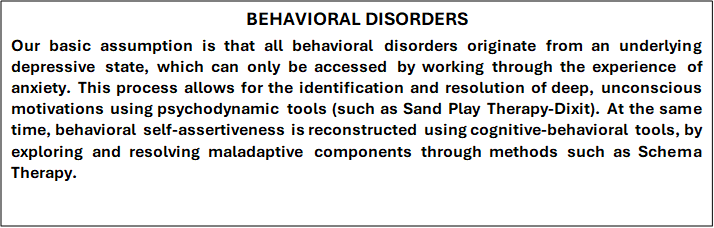
In the Appendices — Table 1 — we have included all projects aimed at the Treatment and Care of deviant and/or maladaptive behavior. This allowed us to take into consideration different diagnoses, for which we adopted both an integrated criterion with respect to shared elements — which we might define as a lowest common denominator — and a differential criterion with respect to the elements that characterize the various psychopathological forms. This operation was made possible by the clinical observation that all pathologies present a common element, often hidden in the unconscious, namely depression, understood here as a factor of integration among the various pathologies. We therefore further hypothesized that the integrated clinical method of treatment may be Play Psychotherapy, which specifically stimulates the patient’s affective instances in every psychopathological form: Play-Focused Dynamic Psychotherapy, which we addressed in another contribution (Grassi et al., 2025). At the same time, the analysis of the specific defense mechanisms for each diagnostic category allowed us to develop differential forms of analysis and intervention among the different pathologies. One may consider, for example, the difference in treatment between the care of OCD and the care of a psychotic onset. All the syndromes described recognize anxiety and the underlying depression as their lowest common denominator. It therefore becomes essential to discuss cognitive disorders and behavioral disorders before addressing anxiety and then depression. The identification of differentiated indicators for each individual disorder was therefore prioritized, while an integrated approach was adopted with regard to the percentages of improvement in the indicators and their respective weights in relation to the duration of the therapeutic project, as follows:
Expected increase for all indicators:
- 15% at the sixth month; 25% at the twelfth month; 45% at the eighteenth month; 60% at the twenty-fourth month.
Increase in the corresponding weights:
- Weights: 40, 30, 20, 10.
- 40 from admission to the sixth month;
- 30 from the sixth month to the twelfth month;
- 20 from the twelfth month to the eighteenth month;
- 10 from the eighteenth month to the twenty-fourth month.
Summary of Behavioral Disorders
- Irresistible impulse;
- Repetitive behaviors;
- Impairment of daily activities.
Treatment
- Psychodynamic therapy: helps identify behaviors and bring them into awareness as reactions to underlying unconscious emotional conflicts.
- Financial support: budget planning and money management with the help of a professional.
- Videogame Therapy.
- Re-Mission: a game designed to support patients during addiction treatment.
- Serious games: educational games designed to help individuals manage behavioral addictions.
General Objective:
Recovery of the patient’s global functioning and their reintegration into the normal school or work pathway, with recovery of their personal, family, school and/or occupational social relationships by at least 60% compared with the beginning of treatment.
Specific Objectives:
- Specific objective: abstinence greater than the abstinence recorded at the time of the patient’s admission to the project.
Indicators:
Specific objective indicator
- Current duration of abstinence.
- Duration of abstinence recorded at admission.
PERSONALITY DISORDERS
Appendix B
Cognitive Disorders
- Negative thoughts: individuals with personality disorders may have persistent negative thoughts about themselves, the world, and the future.
- Cognitive distortions: they may hold irrational or distorted beliefs about themselves and others, such as the belief that they are inadequate or unable to do anything on their own.
- Rumination: a tendency to dwell on past events or current situations, further fueling emotional distress.
BEHAVIORAL DISORDERS
Appendix H
- Avoidance: avoiding situations or activities that may provoke anxiety or discomfort, which may limit daily activities and quality of life.
- Compulsive behaviors: repetitive actions that a person may feel compelled to perform in order to reduce anxiety or discomfort, even though they are not effective in the long term.
- Social isolation: withdrawal from social situations in order to avoid the discomfort caused by interaction with others.
- Impulsive behaviors: impulsive and unreflective actions that may lead to negative consequences.
Treatment
The treatment of personality disorders often includes a combination of psychosocial therapies and, at times, pharmacological therapy [A]. Psychodynamic therapy — TFP — and cognitive-behavioral therapy — CBT — are particularly effective in modifying the dysfunctional thoughts and behaviors associated with personality disorders [Cluster B].
Therapeutic Videogames
- Videogame Therapy: used to treat psychological disorders, including personality disorders.
- Serious Games: games designed for therapeutic purposes, promoting emotional regulation and stress management.
- Immersive experiences: some videogames use virtual reality to help patients confront their difficulties in a controlled environment.
General Objective
Recovery of the patient’s global functioning and their reintegration into the normal school or work pathway, with recovery of their personal, family, school and/or occupational social relationships by at least 60% compared with the beginning of treatment.
Specific Objectives
- Specific objective: frequency of dysfunctional impulsive behavioral acts lower than the frequency recorded at the time of the patient’s admission to the project.
- Specific objective: frequency of negative thoughts lower than the frequency recorded at the time of the patient’s admission to the project.
- Specific objective: frequency of cognitive distortions lower than that recorded at the time of the patient’s admission to the project.
Indicators
Specific Objective Indicator 1
- Current frequency of dysfunctional impulsive behavioral acts.
- Frequency of dysfunctional impulsive behavioral acts recorded at the time of admission.
Specific Objective Indicator 2
- Duration of absence of negative thoughts at the sixth, twelfth, eighteenth, and twenty-fourth month.
- Duration of absence of negative thoughts recorded at the time of admission.
Specific Objective Indicator 3
- Frequency of cognitive distortions at the sixth, twelfth, eighteenth, and twenty-fourth month.
- Frequency of cognitive distortions at admission to the facility.
ADDICTIONS RELATED TO SUBSTANCE USE AND NON-SUBSTANCE-RELATED ADDICTIONS
Compulsive shopping, Internet addiction, pathological gambling, and addiction to psychotropic substances.
APPENDIX A
Cognitive Disorders
The following is an overview of cognitive disorders:
- Recurrent thoughts: individuals often experience intrusive and recurrent thoughts focused on purchasing goods, the possible winning of money, digitalized communication, or the relaxing pleasure of a drug, even when they recognize that these objects are unnecessary, harmful, excessively costly, or energy-consuming.
- Excessive worries: these may concern purchases, potential winnings, and digital technologies for interaction with others. Individuals may experience excessive worries, such as the fear of being unable to resist the impulse or the shame associated with this fact.
APPENDIX G
Behavioral Disorders
This is a group characterized by the loss of control over activities involving self-administration of substances, purchasing, gambling, and compulsive use of digital technology. In the past, scholars debated whether this should be considered a problem of impulse control, an obsessive-compulsive disorder, or, indeed, a behavioral addiction (Aboujaoude, 2014; Andreassen & Pallesen, 2014).
Ultimately, broad agreement was reached with Andreassen & Pallesen (2014) in considering compulsion as a specific addiction, understood in terms of craving, withdrawal, loss of control, and tolerance.
In individuals, it would appear to be conditioned by emotional states rather than by needs. Experiencing emotions perceived as negative may represent the triggering factor for dysfunctional behavior. Usually, the enactment of the behavior may soothe such emotions by generating positive feelings and gratification. Unfortunately, however, after the behavior, the individual tends to fall back into a negative emotional state deriving from guilt or from the perception of lack of self-control. This state may become a new antecedent for the enactment of dysfunctional behavior, thereby generating a vicious circle.
ADHD
Appendix C
Cognitive Disorders
- Inattention — or easy distractibility: poor attention to detail and inability to complete actions once initiated. Children appear constantly distracted, as if they always had something else on their mind; they avoid activities that require attention to detail or organizational skills; they frequently lose important objects and forget important activities.
Appendix I
Behavioral Disorders:
Impulsivity manifests as difficulty in organizing complex actions, with a tendency to shift rapidly from one activity to another and difficulty waiting one’s turn in play and/or group situations. These symptoms are not caused by cognitive deficit, but by objective difficulties in self-control and planning ability. At least six out of nine symptoms/criteria must be met for symptoms of inattention and/or hyperactivity. Symptoms begin before the age of seven. They last for more than six months and determine a significant impairment in the child’s global functioning.
Treatment 2.0
2.1 Individual treatment: Individual treatment helps the patient develop strategies to manage symptoms through awareness of the underlying unconscious conflicts. The frequency of psychotherapy sessions for individuals with ADHD may vary according to the severity of symptoms and individual needs. In general, Psychodynamic Therapy sessions take place once a week and last 45 minutes. The overall duration of treatment depends on the patient’s response and may range from a minimum of eight sessions to twenty-four sessions in ordinary care, up to sessions without predefined time limits in cases of greater need.

Play-Focused Psychodynamic Psychotherapy — Sand Play Therapy or Dixit — promotes focused attention and stillness in a task to be completed: the construction of an imagined scene.
2.2 Psychoeducational interventions: informing the patient and the family about the disorder and how to address it.
2.3 Structuring the environment: creating a stable and predictable environment in order to reduce distractions.
2.4 Training for parents and teachers: strategies for managing behavior and improving the patient’s self-esteem.
2.5 Videogames
- EndeavorRx: the first videogame approved by the FDA for the treatment of ADHD in children. It is available on iOS and can be downloaded from the App Store.
- Serious games for ADHD: games developed to improve attention and memory in children with ADHD.
Educational games: some interactive games are designed to foster concentration and the management of impulsivity.
Recommended list of educational games for ADHD:
- EndeavorRx: a videogame approved by the FDA to improve attention in children with ADHD.
- Cogmed: a working-memory training program, useful for the management of the syndrome.
- Minecraft Education Edition: promotes creativity and concentration through structured activities.
- Brain training games: games designed to improve memory and concentration skills through logic and strategy tasks.
Specific educational games for ADHD:
- Logic and strategy games: some games help develop critical thinking and planning.
- GameTop: offers a wide selection of free logic games for PC, including engaging puzzles and brain teasers.
- Naviga Web: provides a list of twenty free logic and intelligence games, playable directly in the browser without the need for downloading.
- Aranzulla.it: offers a guide to the best online strategy games, available for PC, smartphone, and console.
2.5 Follow-up and monitoring
- Regular assessments: continuous monitoring of progress and/or possible complications.
- Adaptation of treatment: modifications to the therapeutic plan based on the patient’s responses.
Support strategies and resources for families and educators
2.6 Parent training
Parent training is a training program for parents of children with behavioral disorders, such as ADHD. Its objective is to provide parents with the skills and strategies necessary to manage and support their children in the best possible way. Through their own personal psychodynamic therapy, they learn:
- Management of problematic behaviors.
- Communication techniques, that is, improving dialogue and mutual understanding.
- Incentives and positive reinforcement: they may use rewards and praise to promote desired behaviors.
- Organization and routines: structuring the home environment in order to reduce distractions and improve concentration.
This type of training should be conducted by specialized psychologists or therapists and may be carried out either individually or in groups of parents.
General Objective
Recovery of the patient’s global functioning and their reintegration into the normal school or work pathway, with recovery of their personal, family, school and/or occupational social relationships compared with the beginning of treatment.
Specific Objectives
- Specific objective: maintenance of focused attention greater than the attention recorded at the time of the patient’s admission to the project.
- Specific objective: maintenance of complete stillness greater than the hyperactivity recorded at the time of the patient’s admission to the project.
- Specific objective: ability to complete predetermined tasks greater than that recorded at the time of the patient’s admission to the project.
Indicators
Specific Objective Indicator 1:
- Duration of focused attention on individual tasks and/or play activities.
- Duration of focused attention on individual cognitive tasks at the time of admission.
Specific Objective Indicator 2
- Duration of stillness dedicated to individual tasks at the sixth, twelfth, eighteenth, and twenty-fourth month.
- Duration of stillness focused on individual cognitive tasks at the time of admission.
Specific Objective Indicator 3
- Number of predetermined tasks completed at the sixth, twelfth, eighteenth, and twenty-fourth month.
- Number of predetermined tasks completed at admission to treatment.
In conclusion, Attention-Deficit/Hyperactivity Disorder (ADHD) represents a significant challenge for affected individuals and their families. However, through timely and accurate diagnosis, combined with effective therapeutic approaches, it is possible to manage symptoms and improve patients’ quality of life. Pharmacological, psychological, and behavioral interventions, together with continuous and structured support, can help develop adaptive strategies and promote an environment more favorable to personal growth.
EATING DISORDERS
APPENDIX D
Cognitive Disorders in Eating Disorders
The following is an overview:
Cognitive disorders: distorted beliefs regarding food, weight, and body shape. For example, a person with anorexia nervosa may have a distorted perception of their weight and body image.
Perfectionism: an excessively perfectionistic attitude may contribute to the development of eating disorders, as the person seeks to control every aspect of their life, including eating.
Excessive concern: excessive concern about weight and body shape is a common feature of eating disorders.
APPENDIX L
Behavioral Disorders
Behavioral disorders in eating disorders include:
- Abnormal eating behaviors: these behaviors may include food restriction, binge eating, self-induced vomiting, excessive use of laxatives, and compulsive physical exercise.
- Food avoidance: some people with eating disorders may avoid consuming certain foods because of specific concerns, such as color, texture, or smell.
- Compensatory behaviors: after a binge episode, some people may attempt to compensate for excessive food intake through behaviors such as self-induced vomiting or the use of laxatives.
Treatment
The treatment of eating disorders often requires a multidisciplinary approach, which may include:
- PDT and CBT — psychodynamic and cognitive-behavioral therapy: this therapy helps identify and modify cognitive distortions and abnormal eating behaviors through awareness of the unconscious motivations underlying the behavior and its interactive modification.
- Nutritional support: meal planning with a professional and nutrition education.
- Family therapy: in some cases, family therapy may be indispensable in addressing family factors that contribute to eating disorders.
- Videogame Therapy to support mental health.
- Planning gaming time: setting a time limit for daily gaming. This helps prevent long sessions that may lead to sedentary lifestyles and sleep disorders.
- Regular physical activity: incorporating physical exercise into the routine. Even short sessions of activity, such as walking, stretching, or home workouts, can make a significant difference.
- Breaks and rest: regular breaks during gaming sessions to reduce fatigue and improve circulation.
- Socialization and outdoor time: balancing time spent gaming with outdoor activities and socialization with friends and family. This supports emotional and mental well-being.
- Balanced diet: maintaining a healthy and balanced diet, integrating fruit, vegetables, lean proteins, and complex carbohydrates. Eating in front of a screen should be avoided in order to prevent unhealthy eating habits.
- Eating habits of gamers: the challenge lies in finding a balance between the pleasure and immersion of videogames and the need to maintain a healthy lifestyle. The integration of healthy snacks and attention to hydration are essential steps toward this objective. It is important to balance gaming time with physical activity, adequate rest, and socialization.
General Objective
Recovery of the patient’s global functioning and their reintegration into the normal school or work pathway, with recovery of their personal, family, school and/or occupational social relationships by at least 60% compared with the beginning of treatment.
Specific Objectives
- Specific objective: absence of abnormal eating behaviors greater than the frequency recorded at the time of the patient’s admission to the project.
- Specific objective: frequency of abnormal eating behaviors lower than that recorded at the time of the patient’s admission to the project.
Indicators
Specific Objective Indicator 1:
- Duration of absence of abnormal eating behaviors.
- Duration of absence of abnormal eating behaviors at the time of admission.
Specific Objective Indicator 2
- Frequency of abnormal eating behaviors at the sixth, twelfth, eighteenth, and twenty-fourth month.
- Frequency of abnormal eating behaviors at the time of admission.
OBSESSIVE-COMPULSIVE DISORDER — OCD
APPENDIX E
Cognitive Disorders
- Obsessions: these are recurrent, persistent, and unwanted thoughts that cause anxiety and distress. Common examples include fear of contamination, the need for order and symmetry, and blasphemous or aggressive thoughts.
- Excessive worries: people with OCD often have excessive worries about the possible consequences of their obsessions, such as the fear of causing harm to themselves or others.
APPENDIX M
Behavioral Disorders
- Compulsions: these are repetitive behaviors or actions that the person feels driven to perform in order to reduce the anxiety caused by obsessions. Examples include repeatedly washing one’s hands, counting, rereading, or performing specific rituals.
- Rituals: these are physical or mental behaviors carried out in an attempt to reduce the anxiety generated by obsessions. These rituals may be very time-consuming and may significantly interfere with daily activities.
Treatment
The treatment of OCD often includes a combination of psychodynamic therapy — PDT — cognitive-behavioral therapy, and pharmacotherapy. Psychodynamic and cognitive-behavioral therapies bring conscious and unconscious conflicts underlying the symptoms into awareness, and reactualize them within the patient-therapist transference-countertransference dynamic and in the patient’s current daily life. This allows for the resolution of the symptom based on motivational analysis, adaptive treatment of behaviors, and consequent restructuring of the personality. The person is thus helped to resolve behavioral symptoms and dysfunctional beliefs. This involves a restructuring of the patient’s interpersonal and occupational functioning.
Pharmacotherapy is carried out with serotonin reuptake inhibitors — SSRIs — with the addition, in cases of inadequate effects, of a second-generation antipsychotic: risperidone, atypical antipsychotics, or third-generation antipsychotics, in association with psychodynamic therapy. The two strategies, aimed at obtaining an improvement in response, had until now been considered equally effective, although no study had ever undertaken to compare them. In a recent paper published in JAMA Psychiatry, a group of researchers coordinated by Helen Blair Simpson, Professor of Psychiatry at Columbia University Medical College in New York, carried out this comparison for the first time, with very interesting results. The randomized clinical trial, conducted by the US group, involved the recruitment of 100 patients with a prevalent diagnosis of OCD for at least 12 months, of moderate severity — a score on the Yale-Brown Obsessive Compulsive Scale, Y-BOCS, greater than or equal to 16 — who had been receiving pharmacological treatment with an SSRI at the maximum tolerated dose for at least 12 weeks. The enrolled patients were then randomly divided into three different groups which, for eight weeks, added the following to pharmacological therapy:
- Psychodynamic and cognitive-behavioral therapy based on exposure combined with response prevention.
- Psychopharmacological therapy: risperidone, a second-generation antipsychotic.
- Placebo, in tablet form.
Videogames:
- Ricky and the Spider: a serious game developed by the University of Zurich for the treatment of OCD in children. The game integrates elements of cognitive-behavioral therapy to help players understand the disorder and face it.
- Videogame Therapy: used to improve emotional regulation and stress management in patients with OCD.
- MindLight: a neurofeedback-based game that helps children regulate anxiety through relaxation techniques and emotion-management strategies.
- Lumi Nova: a serious game recommended by NICE to help children with anxiety and OCD gradually face their fears.
- Integrated therapeutic strategies: mindfulness and stress management.
Significant Results
- The first significant result is represented by the superiority of psychodynamic and cognitive-behavioral therapy compared with placebo and risperidone. Psychodynamic and cognitive-behavioral therapy, over 50 weeks, is able to provide superior outcomes both in terms of reduction of symptom severity and in terms of improvement in quality of life and general functioning.
- Absence of typically significant differences between placebo and risperidone with respect to the outcomes considered.
In patients in whom residual symptoms persist and heavily limit quality of life, in all cases of inadequate response it is necessary to consider the possible and frequent comorbidity with other disorders, particularly personality disorders, which, as has been widely demonstrated, worsen the outcomes of OCD treatments. We believe that even the success related to the remission of obsessive-compulsive symptoms obtained within a few weeks through cognitive-behavioral therapy is an ephemeral success, insofar as the proposal of more successful behavioral patterns for the patient does not emphasize the deep and unconscious motivational implications underlying the symptoms. For this reason, we favor psychodynamic therapy, which aims precisely at resolving the conflict underlying the symptoms, and is the only approach capable of producing a prolonged and definitive effect over time.
General Objective
Recovery of the patient’s global functioning and their reintegration into the normal school or work pathway, with recovery of their personal, family, school and/or occupational social relationships compared with the beginning of treatment.
Specific Objectives
- Specific objective: reduction in the frequency of obsessions recorded at the time of the patient’s admission to the project.
- Specific objective: reduction in the frequency of compulsions compared with that recorded at the time of the patient’s admission to the project.
- Specific objective: current frequency of compulsive rituals compared with that recorded at the time of the patient’s admission to the project.
Indicators:
Specific Objective Indicator 1:
- Current duration of absence of obsessions.
- Duration of absence of obsessions at the time of admission.
Specific Objective Indicator 2:
- Duration of absence of compulsions at the sixth, twelfth, eighteenth, and twenty-fourth month.
- Duration of absence of compulsions at the time of admission.
Specific Objective Indicator 3:
- Current frequency of compulsions/rituals at the sixth, twelfth, eighteenth, and twenty-fourth month.
- Frequency of compulsions/rituals at admission to treatment.
MCI
Appendix F
Cognitive Disorders
- Memory disorder confirmed by a caregiver.
- Memory decline in relation to age.
- Preserved general cognitive level.
- Preservation of activities of daily living.
- Absence of dementia.
The amnesias of MCI may be of the following types:
- Pure amnestic.
- Pure non-amnestic.
- Multidomain amnestic.
- Multidomain non-amnestic.
Appendix N
Behavioral Disorders
Lowering of mood, loss of empathy, inappropriate behavior in public, disinhibition, hyper-religiosity, stereotyped or ritualistic behaviors, perseveration and excessive mental rigidity, eating alterations — fixations, hyperphagia, and voracity — nocturnal vocalizations or sleepwalking.
Treatment
- Increase in neural reserve through socializing and performance-based activities involving individual and group games.
- Individual psychodynamic psychotherapy for the resolution of problematic unconscious psychic knots and related maladaptive behavioral patterns, both of which interfere with the patient’s cognitive, affective, and behavioral functioning.
- Games that may help stimulate memory and cognitive functions, such as brain training and serious games, to support mental health and slow cognitive decline.
Administration of assessment tests:
- Symptom Checklist-90 — SCL-90; Derogatis et al., 1976.
- Psychosomatic Dysregulation Inventory.
- Relationship Questionnaire — RQ; Bartholomew & Horowitz, 1991.
- Childhood Trauma Questionnaire — Short Form, CTQ-SF; Bernstein & Fink, 2003.
- Toronto Alexithymia Scale — TAS-20; Bagby et al., 2006.
- Personality Assessment Inventory — PAI; Morey, 1991, 2007, 2016.
- Portrait Values Questionnaire — PVQ; Schwartz, 1992, 2001.
- Psychosomatic Dysregulation Inventory — PDI; Caretti et al., 2019.
- Standard Progressive Matrices — SPM; Raven, 1998; Raven, 2009.
General Objective
Recovery of the patient’s global functioning and their reintegration into the normal school or work pathway, with recovery of their personal, family, school and/or occupational social relationships compared with the beginning of treatment.
Specific Objectives
- Specific objective: improvement in cognitive functions greater than that recorded at the time of the patient’s admission to the project.
- Specific objective: improvement in relational-affective functions greater than that recorded at the time of the patient’s admission to the project.
- Specific objective: improvement in performance functions greater than that recorded at the time of the patient’s admission to the project.
Specific Objective Indicator 1:
- Results on tests of cognitive functions.
- Results on tests of cognitive functions at the time of admission.
Specific Objective Indicator 2
- Frequency of relational-affective interactions at the sixth, twelfth, eighteenth, and twenty-fourth month.
- Frequency of relational-affective interactions at the time of admission.
Specific Objective Indicator 3
- Level of performance at the sixth, twelfth, eighteenth, and twenty-fourth month.
- Level of performance at admission to treatment.
RARE DISEASES
APPENDIX O
Cognitive Disorders
- Memory difficulties.
- Concentration problems.
- Lack of attention.
APPENDIX P
Behavioral Disorders
Smith-Magenis syndrome, Huntington’s disease, amyotrophic lateral sclerosis, cerebellar ataxias, Rett syndrome, Prader-Willi syndrome, Angelman syndrome, Williams syndrome, Cornelia de Lange syndrome: violence, outbursts of anger, irritability, problems with anger management, inappropriate behaviors, difficulties in interpersonal relationships, compulsions, hyperactivity, self-harm, phobias/hypersociality (Williams syndrome).
Neurodevelopmental disorders: school problems — ADHD, difficulties in communication and social interaction — autism spectrum disorder, intellectual disabilities — difficulties in learning and daily functioning, language disorders — difficulties in communication, movement disorders — problems with motor coordination and involuntary movements.
Treatment
- Play-Focused Dynamic Psychotherapy.
- Videogame Therapy: the main advantages of VGT lie in the fact that videogames can provide a sense of involvement and immersion that traditional therapeutic methods may not have. They may also teach valuable skills such as problem solving, problem analysis, decision making, and coping strategies. They may also promote emotional literacy, social feeling, a sense of identity, and the activation of cognitive processes. Finally, by simulating real-life scenarios, videogames allow individuals to practice and improve social skills in a safe and controlled environment.
- “Raro chi trova”: a logic game designed to raise awareness of rare diseases, with interactive activities for children and parents.
- “Bravo chi trova”: the third edition of “Raro chi trova”, an awareness campaign on lysosomal storage diseases.
Specific Objectives
- Specific objective: frequency of dysfunctional impulsive behavioral acts lower than the frequency recorded at the time of the patient’s admission to the project.
- Specific objective: frequency of negative thoughts at least 60% lower than the frequency recorded at the time of the patient’s admission to the project.
- Specific objective: frequency of cognitive distortions compared with that recorded at the time of the patient’s admission to the project.
Indicators:
- Specific objective: improvement in the control of dysfunctional behaviors.
- Specific objective: improvement in cognitive functions greater than that recorded at the time of the patient’s admission to the project.
- Specific objective: improvement in relational-affective functions greater than that recorded at the time of the patient’s admission to the project.
- Specific objective: improvement in behavioral control and management functions greater than that recorded at the time of the patient’s admission to the project.
Indicators:
Specific Objective Indicator 1:
- Current frequency of dysfunctional impulsive behavioral acts.
- Frequency of dysfunctional impulsive behavioral acts recorded at the time of admission.
Specific Objective Indicator 2:
- Results on tests of cognitive functions.
- Results on tests of cognitive functions at the time of admission.
Specific Objective Indicator 3:
- Relational-affective functions at the sixth, twelfth, eighteenth, and twenty-fourth month.
- Relational-affective functions at the time of admission.
Specific Objective Indicator 4
- Level of behavioral performance at the sixth, twelfth, eighteenth, and twenty-fourth month.
- Level of behavioral performance at admission to treatment.
PSYCHOTIC ONSET
APPENDIX U
Cognitive Disorders
- Thought disorganization: difficulty maintaining a logical flow in thoughts and language.
- Attention and memory deficits: problems concentrating or remembering information.
- Impairment of executive functions: difficulties in planning, problem solving, and decision making.
APPENDIX V
Behavioral Disorders
- Social withdrawal: a tendency to isolate oneself and reduce interactions with others.
- Bizarre behaviors: unusual or inappropriate actions or attitudes.
- Emotional alterations: apathy, affective flattening, or, conversely, intense and inappropriate emotional reactions.
Positive and negative symptoms:
- Positive symptoms: hallucinations, delusions, distorted perceptions of reality.
- Negative symptoms: apathy, lack of motivation, and reduction in communicative abilities.
These symptoms can significantly affect quality of life and daily functioning.
Treatment
- Antipsychotic psychotropic medications.
- Dynamic psychotherapy.
- Play-Focused Dynamic Psychotherapy.
- Videogame Therapy: a method developed by Italian experts that uses videogames to treat psychological disorders, including psychotic onset.
- Serious games: games designed for therapeutic purposes, promoting emotional regulation and stress management.
- Immersive experiences: some videogames use virtual reality to help the patient confront their difficulties in a controlled environment.
General Objective
Recovery of the patient’s global functioning and their reintegration into the normal school or work pathway, with recovery of their personal, family, school and/or occupational social relationships by at least 60% compared with the beginning of treatment.
Specific Objectives
- Specific objective: reduction of delusions and hallucinations greater than the extent of the same symptoms recorded at the time of the patient’s admission to the project.
- Specific objective: reduction of negative symptoms greater than the extent recorded at the time of the patient’s admission to the project.
- Specific objective: reduction of bizarre behaviors greater than that recorded at the time of the patient’s admission to the project.
Indicators
Specific Objective Indicator 1:
- Current frequency of delusions and hallucinations.
- Their frequency at the time of admission.
Specific Objective Indicator 2:
- Current duration of negative symptoms.
- Their duration at the time of admission.
Specific Objective Indicator 3:
- Current number of bizarre behaviors.
- Number of bizarre behaviors at the time of admission to the care project.
ANXIETY
APPENDIX Q
Cognitive Disorders
- Intrusive thoughts: recurrent and persistent thoughts of worry or fear that are difficult to control.
- Excessive worry: excessive and constant worry about future events or everyday situations, often disproportionate to the actual probability of occurrence.
- Difficulty concentrating: problems maintaining attention, focusing on tasks, or making decisions because of anxiety.
- Rumination: repetitive and cyclical thoughts about negative themes or past events.
APPENDIX R
Behavioral Disorders
- Avoidance: avoiding situations or activities that may provoke anxiety, which can limit daily activities and quality of life.
- Restlessness: agitated behaviors, such as tapping one’s fingers, moving incessantly, or speaking rapidly.
- Compulsive behaviors: repetitive actions that a person may feel compelled to perform in order to reduce anxiety, even though they are not effective in the long term.
- Social isolation: withdrawing from social situations in order to avoid the discomfort caused by anxiety, which may lead to feelings of loneliness.
Treatment
The treatment of anxiety often includes a combination of therapies:
- Psychodynamic therapy: helps identify and modify emotional states that underlie dysfunctional thoughts and behaviors contributing to anxiety.
- Pharmacological therapy: anxiolytics, antidepressants, or beta-blockers may be prescribed to manage symptoms.
- Relaxation techniques: practices such as meditation, yoga, and deep breathing may help reduce anxiety levels.
- Psychological support: working with a therapist or counselor to address the underlying causes of anxiety and develop alternative strategies proposed by the cognitive unconscious — R. Langs, 1988.
Videogames for anxiety:
- Celeste: a platform game that explores anxiety through the story of the protagonist, Madeline, who faces her fears by climbing a mountain, Celeste. Looking at herself in the mirror, the girl first sees herself with purple hair, white skin, and red eyes. Pausing for a second, she decides to look at herself again and once more sees this distorted reflection, which then manages to escape. It is later revealed that this figure is Badeline, also described as the protagonist’s “dark side”. She represents Madeline’s insecure part, embodying her fears: loneliness, inadequacy, despair, and many others. During her climb, the girl often experiences mental health difficulties, including severe panic attacks caused by the dangerous situations in which she finds herself. In the end, Madeline merges with Badeline, who thus serves as moral support in reaching the summit.
- Adventures with Anxiety: a free indie game that helps players understand and manage anxiety strategically. It is essentially an interactive videogame, an adventure in which users make choices in the company of their own anxiety. The latter takes the form of a pet animal; in the protagonist’s case, it is a red wolf, but it could be anyone. Awareness of the unconscious is the only strategy through which the shadows cease to be shadows and become illuminated by that small lantern that is consciousness.
- Life is Strange: a narrative adventure that addresses themes related to depression and anxiety through the player’s choices. The protagonist of the videogame reaches a precarious state of mental health involving depression and suicidal impulses. If the player manages to convince her through the right dialogue choices, the protagonist will not die by suicide and will recover in a hospital bed. If, however, the player fails, a memorial to her will be shown on the steps in front of the dormitory.
General Objective:
Recovery of the patient’s global functioning and their reintegration into the normal school or work pathway, with recovery of their personal, family, school and/or occupational social relationships by at least 60% compared with the beginning of treatment.
Specific Objectives
- Specific objective: reduction in anxiety episodes greater than the number of episodes recorded at the time of the patient’s admission to the project.
- Specific objective: reduction in the number of avoidances of anxiety-provoking situations greater than the number recorded at the time of the patient’s admission to the project.
- Specific objective: reduction in the number of ruminations greater than that recorded at the time of the patient’s admission to the project.
Indicators
Specific Objective Indicator 1:
- Duration of absence of anxiety episodes.
- Duration of absence of anxiety episodes at the time of admission.
Specific Objective Indicator 2:
- Frequency of avoidance episodes at the sixth, twelfth, eighteenth, and twenty-fourth month.
- Frequency of avoidance episodes at the time of admission.
Specific Objective Indicator 3:
- Reduction in the number of ruminations at the sixth, twelfth, eighteenth, and twenty-fourth month.
- Number of ruminations at admission to treatment.
DEPRESSION
APPENDIX S
Cognitive Disorders
- Recurrent negative thoughts: people with depression often experience persistent negative thoughts about themselves, their future, and the surrounding world. These thoughts may include feelings of worthlessness, hopelessness, and guilt.
- Rumination: a tendency to dwell on negative events or past mistakes, further fueling the depressive cycle.
- Difficulty concentrating: problems maintaining attention, making decisions, and carrying out daily activities because of reduced cognitive abilities.
- Low self-esteem: a distorted and negative perception of oneself, accompanied by feelings of inadequacy and failure.
APPENDIX T
Behavioral Disorders
- Social withdrawal: a tendency to isolate oneself from others, avoiding social contacts and activities that were previously pleasurable.
- Inactivity: a significant decrease in physical activity and interest in normal daily activities.
- Sleep disturbances: problems with insomnia or hypersomnia — sleeping too much — which may worsen general health conditions.
- Appetite changes: loss of appetite or, conversely, excessive food consumption, which may lead to weight changes.
Treatment
The treatment of depression may include a combination of therapies:
- Psychodynamic therapy: helps identify the unconscious conflicts underlying the dysfunctional thoughts and behaviors that contribute to depression.
- Pharmacological therapy: antidepressants such as SSRIs — selective serotonin reuptake inhibitors — or SNRIs — serotonin-norepinephrine reuptake inhibitors.
- Physical activity: regular exercise may improve symptoms and reduce depression.
- Psychological support: working with a therapist or counselor to explore the conflicts underlying depression and develop alternative behavioral strategies indicated by the cognitive unconscious — Langs, 1988.
Videogames for depression:
- SPARX: a serious game developed for adolescents with depression. It helps players develop strategies to cope with negative thoughts.
- Thymia: a system that uses videogames to diagnose and monitor depression. It uses artificial intelligence to analyze the player’s behavior and provide useful data to healthcare professionals. The program is structured as follows: patients affected by depression simply play specially designed videogames, with neuropsychological support, enabling researchers to measure and monitor the depressive state and any possible evolution. The software uses artificial intelligence and is able to measure the patient’s behavior and body language: voice, gaze, expressions, and reactions. In short, patients are focused on playing, while software analyzes what is happening and what the depressive state is.
- Therapeutic videogames: some studies suggest that games designed for brain training may improve cognitive functions and reduce depressive symptoms.
General Objective:
Recovery of the patient’s global functioning and their reintegration into the normal school or work pathway, with recovery of their personal, family, school and/or occupational social relationships by at least 60% compared with the beginning of treatment.
Specific Objectives
- Specific objective: reduction in the frequency of negative thoughts.
- Specific objective: reduction in the frequency of sleep or appetite problems.
Indicators
Specific Objective Indicator 1:
- Current frequency of negative thoughts.
- Frequency of negative thoughts at the time of admission.
Specific Objective Indicator 2:
- Duration of absence of sleep or appetite problems.
- Duration of absence of sleep or appetite problems at the time of admission.
CONCLUSIONS
A comparative analysis of the syndromic frameworks described has allowed us to highlight that, just as the common therapeutic factor is play, understood as a relational instrument with others and with one’s own inner world, so the common factor underlying the various symptomatic forms of behavioral disorders is death anxiety and the related specific symptomatology of depression. All disorders are traversed, as a dimensional symptom, by anxiety; and anxiety, in turn, finds its most significant expression in death anxiety, even within the categorical and dimensional diversity among the different disorders. The increase in behavioral disorders in the current social context is strongly correlated with the rise in depression that contemporary society is undergoing. The defenses collectively put in place manifest themselves in various ways:
A) a strong acceleration of the rhythms and commitments of life.
B) the increasingly marked spread of a boundless aggressiveness in social relationships, from the most intimate forms, such as domestic violence, to the most striking episodes, with increasingly frequent acts of violence against others.
C) a manicization of mood in different human contexts.
D) the exaggerated aestheticization of the expression of the self and of one’s personal and social identity.
The modalities thus aroused serve to express that inability to internalize the personal limits and boundaries that are indispensable to healthy interpersonal relatedness. Indeed, these limits and boundaries immediately evoke an intolerable death anxiety, against which one defends oneself by projecting death onto others or onto oneself. This is precisely what occurs in behavioral disorders, which, given their now epidemic spread, require a response from healthcare institutions through the organization of services dedicated to psychic fragility.
In primitive social organizations, death was not banished, but was included as a present and significant element for the very subsistence of the social group. Today, by contrast, death is banished, and acts unconsciously within the individual and within the social order, outside their awareness.
The interventions of the institutions of the National Health Service have instead the aim, through the instrument of Play, of re-establishing, between individual and society, on the one hand the reality of the experience of death, and on the other hand a relationship with it that may be fruitful for the psychological development and maturation of all. Our contribution, both theoretical, through writings such as this one, and clinical, through psychotherapy, is directed toward the achievement of the objective of collective psychological growth, “Beyond Yahweh and Christus,” as hoped for by Robert Langs (2007) in one of the most significant writings of his later years, not translated — and not by chance — in Italy.
BIBLIOGRAPHY
Aboujaoude E. (2014) Compulsive buying disorder: a review and update. Curr Pharm Des. 2014; 20(25):4021-5. doi: 10.2174/13816128113199990618. PMID: 24001296.
American Psychiatric Association (APA) (2013). Diagnostic and Statistical Manual of Mental Disorders (Sth ed.).
Barkley, R.A. (2015). Attention-Deficit Hyperactivity Disorder: A Handbook for Diagnosis and Treatment. New York: Guilford Press
Faraone, S.V., et Biederman, J. (2005). “ADHD in Adults: A Review of the Literature”. Journal of Attention Disorders, 9, 3-10.
Grassi A., Berivi S., Camerlingo C., Casamassima S., Russello C., Romano B., Sinatti C., Alvisi F., Allocca A (2025) Transnographic clinical framework for Psychodynamic Play Focused Semi-Residential Territorial Care. LIRPA International Journal (DOI 10.48237/LIJ_095) vers. It. (DOI 10.48237/LIJ_087).
Langs. R. (1988) – Guida alla Psicoterapia – Bollati Boringhieri, Torino,1988.
- (2007) Beyond Yahweh and Jesus: Bringing Death’s Wisdom to Faith, Spirituality, and Psychoanalysis. Jason Aronson Publishers,
National Institute for Health and Care Excellence (NICE). (2018). Attention Deficit Hyperactivity Disorder: Diagnosis and Management (NICE Guideline 87)
Pliszka, S.R. (2007). “Neuropsychiatric Aspects of Attention Deficit Hyperactivity Disorder: insights from Brain imaging”. Journal of Child Neurology, 22, 694 – 701.
Tannock, R. (2003). “Attention Deficit Hyperactivity Disorder: Advances in Cognitive, Neurobiological, and Genetic Research” Journal of Child Psychology and Psychiatry, 44, 65 – 69.
Videogiochi
- Estelle L. Weinrib . The Sand Play Therapy Process – Images of the Self. books.google.com, 2004.
- SPARX- Serious Game -Apple Store e Google Play-pub Ahmed, Google scholar, Research gate.
- Thymia-articolo in “il Giornale”-Google scholar.
- Celeste-Adventures with Anxiety- Life is Strange. Piattaforme Internet: Steam, PlayStation Štore, Xbox Štore, Nintendo eShop.
- Videogame Therapy-Serious games-esperienze immersive. Steam, PlayStation Štore, Xbox Štore, Nintendo eShop
- “Raro chi trova”-Takeda Italia.
- EndeavorRX-Serious games per ADHD-Giochi educativi-Steam, PlayStation Štore, Xbox Štore e Nintendo eShop.
- Giochi di logica e strategia: GamesTop-NavigaWeb-Aranzulla.it